Jun
21
2026
 Mizutech VoIP-AI Integration Strategy
In this blog post I would like to reveal our short-mid term AI strategy.
Everyone and their mother is talking about artificial intelligence nowadays and most companies tries their best to not miss the AI hype.
Hype or not, generative AI brings real benefits and software companies must think seriously about how to improve their products with AI.
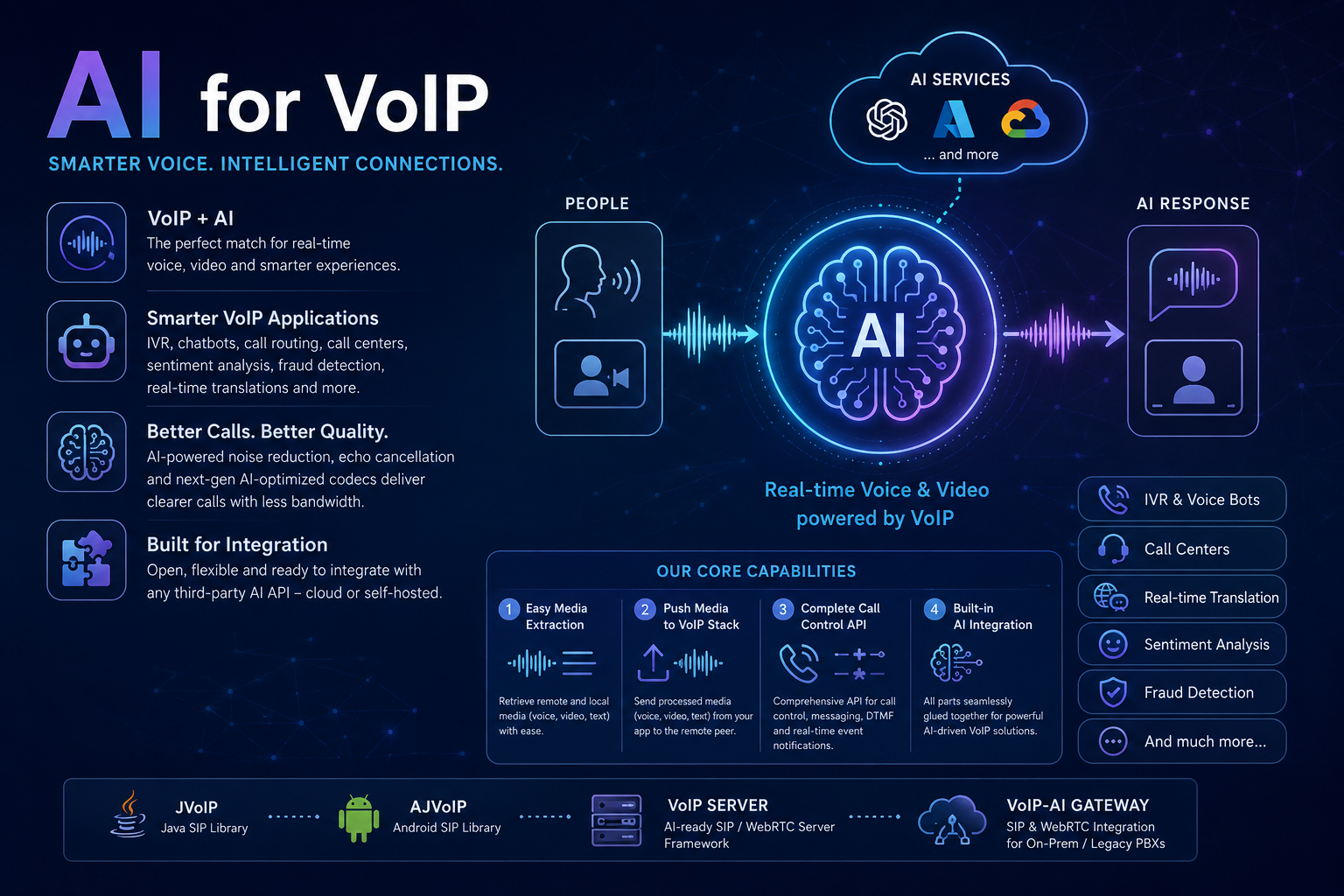
For VoIP, the marriage is inevitable. Voice and video have become the primary interfaces for humans to interact with AI. You need VoIP to bring real-time voice/video from people to AI, and you need VoIP to deliver AI responses back to people as natural speech or video.
Beyond that obvious synergy, AI can dramatically improve several areas native to VoIP. Think about IVR's, chatbots, content based automated call routing, call centers, sentiment analysis, fraud detection or real time translations.
Even the VoIP core infrastructure can take a lot of advantage from VoIP as AI can be used to improve call quality (AI powered noise reduction, echo cancellation). Actually Google and Microsoft started to develop new audio codec's optimized by AI technology with better quality/compression ratio then traditional codec's.
We have been discussing what would be the best path forward for us regarding AI and we arrived to a simple conclusion: we must enable AI across our entire VoIP software portfolio. Our new AI integration modules not only add AI capabilities to our software, but also enable seamless integration between SIP/WebRTC and AI for existing PBX systems.
More exactly we are about to prepare all our VoIP software for seamless integration with any third-party AI API, be it cloud or self-hosted. The integration can be used directly with an STS (Speech-to-Speech) API or with a STT (Speech-to-Text) - LLM - TTS (Text-to-Speech) pipeline. Our goal is to make the integration as easy, robust and performant as possible.
In practice, this means the implementation of the following core capabilities:
- Easy media extraction (voice/video/text)
You will be able to retrieve both the remote and the local media (for typical use-case you will need the received audio to be forwarded to AI API)
- A simple way to push media (voice/video/text) from your app to our SIP software (to be streamed to the remote peer).
For example you will be able to auto-answer a call, forward the remote media to your AI engine, make any processing (translation, chatbot, etc) and send the answer to the remote peer as text, voice or video.
- API for call control and for all the other common tasks what you might expect from a VoIP stack: connect/register, initiate calls, (auto) answer calls, call forward, call transfer, send receive chat/text and DTMF, get notifications about important events (registered, call start, ringing, connected, disconnected, incoming chat/dtmf, etc).
- Built-in AI integration gluing the above parts together.
We already completed this architecture for our Java SIP library (JVoIP) and Android SIP library (AJVoIP), sharing the same AI integration related modules.
If you are a Java developer, then you can start adding SIP-AI integration to your app as described here.
There is also a SIP-AI CLI which can be used to easily add an AI extension into any SIP server or PBX.
We are also creating an AI framework for the VoIP server preparing for any kind of custom SIP/WebRTC - AI integration and we also plan to release a VoIP-AI gateway soon to enable SIP-VoIP and WebRTC-VoIP integration for on-prem or legacy PBXs.
Contact us with your idea or requirements and we will reply with a complete plan and implementation timeline.